
· Factors & impact before the US-tariff issues: Europe’s volatile supply chain of materials for EV production, very high energy costs due to geopolitical tensions and dependency on China has increased production costs. Harsh competition with Chinese OEMs both in China and Europe causes sales and profit downturn of European OEMs and increasing job cuts. The slow transition to BEVs and strategical failures in recent years, such as focusing too heavily on luxury EVs and SUV’s as well as the BEV-only powertrain strategy, has forced European OEMs to a fundamental direction shift.
· The impact of US tariffs: The 15% US tariffs will increase US market prices of vehicles from the EU by around 8% (or around $4,300) on average, with the stronger euro exacerbating the impact. Especially, German OEMs face significant risks due to their substantial US reliance (24% of Germany’s non-EU car exports).
· Increasing defence expenditure: In 2025, NATO Allies has increased their commitment to defence investment from 2% to 5% of GDP annually. Also, the EU’s ‘Readiness 2030’ package will support Europe’s defence industry. These strategies will shift industrial priorities and bases, with some crossover effects on automotive development.
· Policy & strategy adjustments to mitigate the impacts: The EU introduced ‘Industrial Action Plan for the European Automotive Sector’ in 2025, to secure the industry’s long-term competitiveness, accelerate the transition to ZEVs, and strengthen supply chains. The Plan offers the OEMs more flexibility to meet their CO₂ standard. Also, the European Commission dropped the ICE ban of 2035, replacing it with an enforced 90% reduction of their 2021 tailpipe emissions in 2035, but with the possibility to still sell ICE and hybrid powertrains. From these The OEMs’ countermeasures include revising their BEV-only strategy with a more multi powertrain approach, lower-priced model portfolios, production shifts in the US and China, potential model discontinuation in the US or even stopping exports to the US, and new modular designs for vehicles and production cost saving.
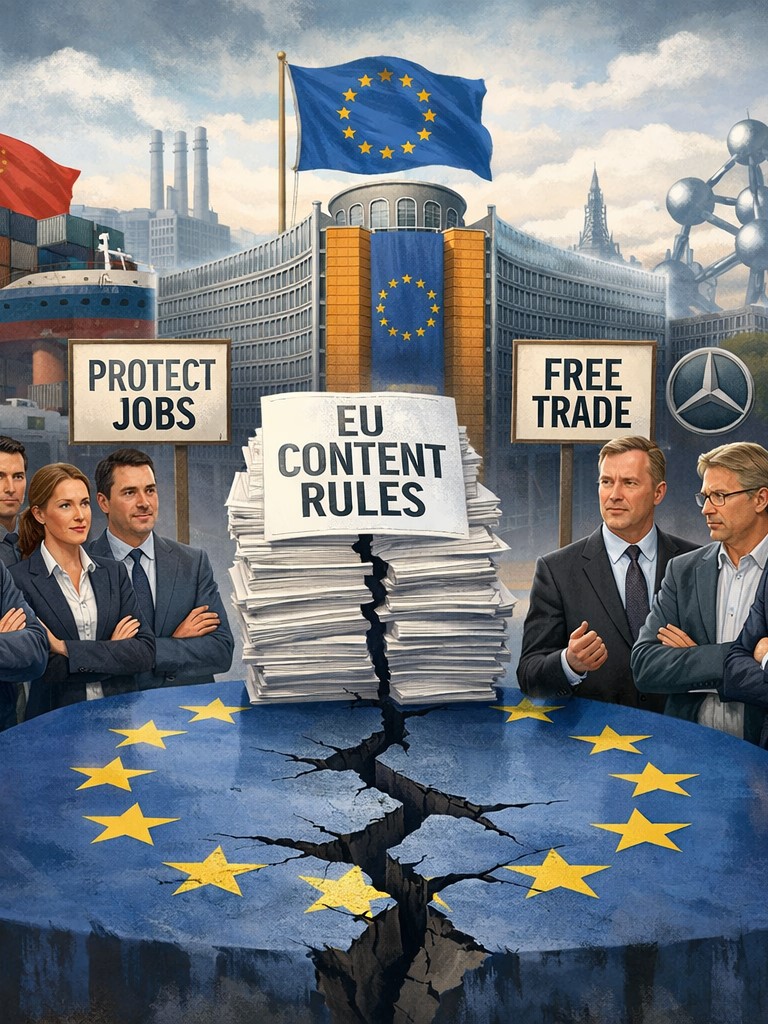
欧州自動車産業への最近の政治経済の影響とその対策
· 米国関税問題以前の欧州における構造的課題:EV用資材サプライチェーンの不安定、エネルギー価格高騰による生産コストの上昇、中国などアジアメーカーへの依存。中国・欧州両市場での中国自動車メーカー台頭による欧州OEMの販売・利益低下と大規模な雇用削減。加えてBEVへの移行遅滞、SUVや高級EVへの過重投資、BEVに特化したパワートレイン戦略などの失策で、欧州OEMは根本的な方向転換を迫られている。
· 米国関税の影響:15%の米国関税により、EUからの輸入車の米国市場価格は平均約8%(約4,300ドル)上昇し、ユーロ高がそれに拍車をかける。米国依存の高いドイツOEM(ドイツ車のEU圏外輸出の24%が米国向け)への影響は特に深刻だ。
· 防衛費の増加:2025年、NATO加盟国は国防費のGDP比目標を年2%から5%に引き上げ、EUも欧州の防衛産業支援策を導入。これにより優先産業と産業拠点が再編され、自動車開発に影響する可能性がある。
· リスク緩和政策と戦略転換:同じく2025年、EUは自動車産業の長期的競争力の確保、ZEVへの移行加速、サプライチェーン強化を目的とした「欧州自動車産業行動計画」を導入。同計画ではOEMのCO₂基準達成が柔軟化された。欧州委員会も2035年のICE禁止を撤回。欧州OEMは、BEV特化戦略の見直しとICE復活、低価格モデルの拡充、生産拠点の米国・中国へのシフト、米国向けモデルの廃止や対米輸出の停止、車両と生産のモジュール化などの対策を講じつつある。